Hi bookies!
Ya know, I haven't been doing a good job of blogging since the turn of the year. Yeah, I'm working on a book, but I've been doing that for 3 years now and the research will be years more, so that's no excuse. And, yes, I have another massive personal project going, and the usual family type stuff that everybody has. That's all true.
But still.
What I can do is start working through my rather massive backlog of Crime Fiction and SFF reviews. No need for links that may eventually go dead, just ramblings from yours truly. Oh boy, you're thinking, lucky me. Well, I'm really not so bad at the reviewing thing. My editor at ILAM seems to like some of my stuff. So we'll see.
A shout-out to my newest follower, Kim Smith, whom I'll bet I've met in my doings about town in Memphis. Hey Kim, you're a member of Sisters In Crime, aren't you?
Thursday, February 25, 2010


Wednesday, February 17, 2010
Winnie...yet again
Good morning bookies!
West Tennessee is bathed in this eerie yellow light, something at once familiar and alien. Simultaneously, the sky is an odd color: blue. The temperature is still way below normal, of course. Global warming, don't you know?
There is a new biography of Churchill, as if you needed one. And I know what you're thinking, 'great, another 1200 pages I've gotta read.' But this one is different. This biography doesn't go along with the recent trend of bashing Churchill as some sort of clownish dolt that somehow didn't keep England from winning World War Two, no, this one actually gives the man credit for leading the winning side and perhaps having something to do with victory in 1945. Plus, it's only 192 pages long!
I'm not sure how you could write a Churchill biography that's only 192 pages, but apparently you can and I, for one, am glad of it. Anything that might get younger folks to read up on one of the 20th centuries greatest men..
New Churchill biography for less than 5 pounds (that's weight, not money)
West Tennessee is bathed in this eerie yellow light, something at once familiar and alien. Simultaneously, the sky is an odd color: blue. The temperature is still way below normal, of course. Global warming, don't you know?
There is a new biography of Churchill, as if you needed one. And I know what you're thinking, 'great, another 1200 pages I've gotta read.' But this one is different. This biography doesn't go along with the recent trend of bashing Churchill as some sort of clownish dolt that somehow didn't keep England from winning World War Two, no, this one actually gives the man credit for leading the winning side and perhaps having something to do with victory in 1945. Plus, it's only 192 pages long!
I'm not sure how you could write a Churchill biography that's only 192 pages, but apparently you can and I, for one, am glad of it. Anything that might get younger folks to read up on one of the 20th centuries greatest men..
New Churchill biography for less than 5 pounds (that's weight, not money)
Sunday, February 14, 2010
So long Dick Francis & William Tenn
Hi bookies, it's a cold, gray day again in West Tennessee and that seems fitting.
***We say goodbye to Dick Francis, aged 89. Master of the horse-thriller, so to speak, with a risque sense to him. I remember when his wife died he didn't think he could go on writing, but he did. As a writer, to go right on writing right up until the last words are written, well, that's about as good as it gets.
RIP Dick Francis
***Not satisfied with just taking Francis, the Grim Reaper also came for William Tenn, noted SFF writer, also aged 89. Tenn's real name was Phillip Klass. He stopped writing SFF nearly 40 years ago but his short work was so iconic that in 2004 he was named a Grandmaster of the genre.
Farewell William Tenn
***We say goodbye to Dick Francis, aged 89. Master of the horse-thriller, so to speak, with a risque sense to him. I remember when his wife died he didn't think he could go on writing, but he did. As a writer, to go right on writing right up until the last words are written, well, that's about as good as it gets.
RIP Dick Francis
***Not satisfied with just taking Francis, the Grim Reaper also came for William Tenn, noted SFF writer, also aged 89. Tenn's real name was Phillip Klass. He stopped writing SFF nearly 40 years ago but his short work was so iconic that in 2004 he was named a Grandmaster of the genre.
Farewell William Tenn
Thursday, February 4, 2010
A new FDR conspiracy
Good morning bookies.
The morning dawned gray, cold and misty here in West Tennessee. The next week promises to be gray, cold and misty here in West Tennessee. My solution so this doesn't happen in the future? Eradicate ground hogs before next year.
How did FDR die? That question has been around for a while now, the official explanation that he suffered a massive (and unforeseen) stroke was lame even when the disinformation police came out with it in 1945. Anybody who saw the man at Yalta or after could clearly see he was dying, and the effects of his debilitation cost the free world greatly. Stalin was going to grab whatever he could, Churchill wanted to stand up to him but by 1945 Britain was enfeebled and toothless, but FDR was too far gone mentally to be a threat to Russia. The result? So long Poland, bye-bye Czechs! Enjoy life behind the Iron Curtain.
A new book claims that FDR did not, in fact, die of a stroke, but instead died of metastasized melanoma that settled in his brain. I haven't read the book in question but the diagnosis seems to fit the facts and is at least as likely as the official explanation.
Did FDR really die of cancer?
The morning dawned gray, cold and misty here in West Tennessee. The next week promises to be gray, cold and misty here in West Tennessee. My solution so this doesn't happen in the future? Eradicate ground hogs before next year.
How did FDR die? That question has been around for a while now, the official explanation that he suffered a massive (and unforeseen) stroke was lame even when the disinformation police came out with it in 1945. Anybody who saw the man at Yalta or after could clearly see he was dying, and the effects of his debilitation cost the free world greatly. Stalin was going to grab whatever he could, Churchill wanted to stand up to him but by 1945 Britain was enfeebled and toothless, but FDR was too far gone mentally to be a threat to Russia. The result? So long Poland, bye-bye Czechs! Enjoy life behind the Iron Curtain.
A new book claims that FDR did not, in fact, die of a stroke, but instead died of metastasized melanoma that settled in his brain. I haven't read the book in question but the diagnosis seems to fit the facts and is at least as likely as the official explanation.
Did FDR really die of cancer?
Sunday, January 31, 2010
Ice Bound
Hiya bookies!
Rumors of my demise are greatly exaggerated. As I've told you before, sometimes Life insists of intruding into my ventures in bookdom. So it has been. Did I tell you I'm back in school? Online courses are incredibly amazing. I submitted my first book report 10 days ago and have yet to get a grade. With my luck it'll probably be a C-.
*** Stephen Hunter was in at Davis Kidd Books in Memphis on January 5th, supporting his new book, I, Sniper. It's a Bob Lee Swagger book, maybe the best one to date. I have a full review currently up on ILA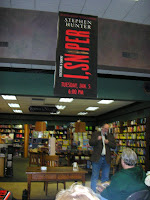 M. www.iloveamysterynewsletter.com. He answered a lot of questions during a 25 minute chat. I asked whether we could expect a Nick Memphis novel and he said no, that Nick is a great supporting character but he doesn't think he could carry an entire novel. Makes sense. He also said that the next book will feature a new, young sniper, sort of a protege for Bob Lee, who is getting a little long in the tooth. He signed books quickly and with dispatch and, all in all, it was quite the good time. The crowd was much larger than I had expected, maybe 50 people in all.
*** A week later Davis Kidd hosted the great grand-nephew of Bram Stoker, Dacre (pronounced Day-ker) Stoker, who along with Ian Holm used outtakes and unused plot bits, as well as the surviving notes from Bram, to produce a sequel to Dracula, namely Dracula-The Undead. I had expected an accent, maybe British, maybe Irish, but the one we heard was South Carolina. Go figure. Anyway, Stoker went into great detail about who Bram Stoker was, what might have influenced him to write Dracula, with Jack the Ripper being a surprise I had never considered, and where he and Holm found their research materials. He also laid out the family tree. The book has sold extremely well world-wide, yet Stoker remained approachable and quite humble. Nice guy. I wanted a photo with him but Davis Kidd doesn't have people to help with that sort of thing anymore, I guess, because nobody is ever around when I want one. So here's one I took after he signed my book and he was doing others.
Rumors of my demise are greatly exaggerated. As I've told you before, sometimes Life insists of intruding into my ventures in bookdom. So it has been. Did I tell you I'm back in school? Online courses are incredibly amazing. I submitted my first book report 10 days ago and have yet to get a grade. With my luck it'll probably be a C-.
*** Stephen Hunter was in at Davis Kidd Books in Memphis on January 5th, supporting his new book, I, Sniper. It's a Bob Lee Swagger book, maybe the best one to date. I have a full review currently up on ILA
 M. www.iloveamysterynewsletter.com. He answered a lot of questions during a 25 minute chat. I asked whether we could expect a Nick Memphis novel and he said no, that Nick is a great supporting character but he doesn't think he could carry an entire novel. Makes sense. He also said that the next book will feature a new, young sniper, sort of a protege for Bob Lee, who is getting a little long in the tooth. He signed books quickly and with dispatch and, all in all, it was quite the good time. The crowd was much larger than I had expected, maybe 50 people in all.
*** A week later Davis Kidd hosted the great grand-nephew of Bram Stoker, Dacre (pronounced Day-ker) Stoker, who along with Ian Holm used outtakes and unused plot bits, as well as the surviving notes from Bram, to produce a sequel to Dracula, namely Dracula-The Undead. I had expected an accent, maybe British, maybe Irish, but the one we heard was South Carolina. Go figure. Anyway, Stoker went into great detail about who Bram Stoker was, what might have influenced him to write Dracula, with Jack the Ripper being a surprise I had never considered, and where he and Holm found their research materials. He also laid out the family tree. The book has sold extremely well world-wide, yet Stoker remained approachable and quite humble. Nice guy. I wanted a photo with him but Davis Kidd
 doesn't have people to help with that sort of thing anymore, I guess, because nobody is ever around when I want one. So here's one I took after he signed my book and he was doing others.
Wednesday, December 16, 2009
Watch on the Rhine
Hiya Bookies! Sorry for the delay in blogging, life happens.
65 years ago today, December 16, 1944, the Germans launched Operation Watch on the Rhine, known to them as the Ardennes Offensive and to the Allies as the Battle of the Bulge. There have been literally hundreds of books written about this battle, from both perspectives, and in my experience many of them would make a fine gift for the World War II buff. In particular I like Charles MacDonald's A Time For Trumpets. He was a company commander for the US during the battle, his prose is clean and clear.
But for those in the US, especially, it is necessary to put the Bulge into context. At the time most US generals panicked when the attack came. The German plan was to attack a weak spot in the American lines, break through and cross the Meuse River, then swing north and re-take Antwerp, thus cutting off all US, British and Canadian troops to their north and east. In short, to re-create their crushing victory of 1940. The problem was that the Germans simply didn't have the manpower to pull it off, and the German General Staff knew it. The only person wholly in favor of throwing in the very last of Germany's offensive striking power, not to mention her last troops reserves and every drop of gasoline they could siphon out of the pipeline, was Adolf Hitler. And anything less than total victory would be a defeat, making the subsequent Allied counter-attack all the more successful as fewer Germans would be around to stop it.
And that's more or less what happened. The Germans attacked but never had the weight necessary to even cross the Meuse River, much less attack Antwerp. They inflicted a lot of casualties but suffered more than twice as many as they caused. Patton knew right away that is was a huge mistake and took advantage. Hitler made things worse by not allowing the attack to be called off even when it had clearly failed. When the Allies finally did counter-attack later in 1945, there were tens of thousands fewer Germans left to defend their homeland, and more than 1,000 irreplaceable tanks no longer on hand to help.
But just because we can see this clearly now doesn't mean it was so clear then, nor does it alleviate the suffering our troops went through in one of the coldest winters on record. When you see the aged veteran who suffered through this ordeal, throw him a salute and remind him how thankful we are for his service. Sitting in a foxhole covered with ice and snow as German tanks were heading for you would not have been any easier if you knew that it was a huge strategic mistake. It would have been just as terrifying as if you were fighting to hold the Germans out of Washington, DC. It would have been just as cold as winter is anywhere, and if the Germans shot you it would not have mattered how much faster their foolish attack might end the war.
65 years ago today, December 16, 1944, the Germans launched Operation Watch on the Rhine, known to them as the Ardennes Offensive and to the Allies as the Battle of the Bulge. There have been literally hundreds of books written about this battle, from both perspectives, and in my experience many of them would make a fine gift for the World War II buff. In particular I like Charles MacDonald's A Time For Trumpets. He was a company commander for the US during the battle, his prose is clean and clear.
But for those in the US, especially, it is necessary to put the Bulge into context. At the time most US generals panicked when the attack came. The German plan was to attack a weak spot in the American lines, break through and cross the Meuse River, then swing north and re-take Antwerp, thus cutting off all US, British and Canadian troops to their north and east. In short, to re-create their crushing victory of 1940. The problem was that the Germans simply didn't have the manpower to pull it off, and the German General Staff knew it. The only person wholly in favor of throwing in the very last of Germany's offensive striking power, not to mention her last troops reserves and every drop of gasoline they could siphon out of the pipeline, was Adolf Hitler. And anything less than total victory would be a defeat, making the subsequent Allied counter-attack all the more successful as fewer Germans would be around to stop it.
And that's more or less what happened. The Germans attacked but never had the weight necessary to even cross the Meuse River, much less attack Antwerp. They inflicted a lot of casualties but suffered more than twice as many as they caused. Patton knew right away that is was a huge mistake and took advantage. Hitler made things worse by not allowing the attack to be called off even when it had clearly failed. When the Allies finally did counter-attack later in 1945, there were tens of thousands fewer Germans left to defend their homeland, and more than 1,000 irreplaceable tanks no longer on hand to help.
But just because we can see this clearly now doesn't mean it was so clear then, nor does it alleviate the suffering our troops went through in one of the coldest winters on record. When you see the aged veteran who suffered through this ordeal, throw him a salute and remind him how thankful we are for his service. Sitting in a foxhole covered with ice and snow as German tanks were heading for you would not have been any easier if you knew that it was a huge strategic mistake. It would have been just as terrifying as if you were fighting to hold the Germans out of Washington, DC. It would have been just as cold as winter is anywhere, and if the Germans shot you it would not have mattered how much faster their foolish attack might end the war.
Monday, December 7, 2009
BLACK CROSS by Greg Iles


Black Cross by Greg Iles. Dutton, 1995. First edition identified by number line ending in '1.'
Iles 2nd book, like his first, deals with Nazis. Except this time it's actually a World War 2 thriller that is quite taut and very well written. You could already see his talent on display in this book, a well-rounded and mature adventure that preceded the chilling Mortal Fear.
Iles is also one of the better authors to hear in person. He's funny, honest and pretty much answers anything, including how much he gets paid for each book. By all means see him if you get the chance.


Thursday, December 3, 2009
The dangers of re-reading a book
Good morning bookies!
Bright sunshine today in West Tennessee, but cold, high 30's, which to me might as well be Antarctica.
No link today, just a passing thought. I guess you all know I'm researching a book dealing with World War II. Whether or not the book ever actually gets written, I don't know, but I research it daily. Last night about 11:30 I was re-reading (for the umpteenth time) The Last 100 Days by John Toland, a book I probably could repeat large swatches off by heart. And what did I suddenly find that I had never found before? A major error. How could I have missed it? Moreover, how could his editors have missed it, not to mention the historian himself?
On page 205 he mentions that Sepp Dietrich's Sixth Panzer Army had lost 30% of its tanks and AFVs attempting to relieve Budapest.
Ummm...no, it didn't. Budapest fell on February 11-12, with breakouts continuing for a few more days by small groups. The three relief attempts in January and February were all carried out by Sixth Army, commanded by Hermann Balck, not Sixth Panzer Army commanded by Sepp Dietrich. Sixth Panzer Army wasn't even fully in Hungary yet and did not actually fight in that area until the offensive on the Gran River later in the month. How had I never noticed this before? And how many other errors have I overlooked in this book?
It just goes to show you that re-reading a favorite book isn't always a good thing.
Bright sunshine today in West Tennessee, but cold, high 30's, which to me might as well be Antarctica.
No link today, just a passing thought. I guess you all know I'm researching a book dealing with World War II. Whether or not the book ever actually gets written, I don't know, but I research it daily. Last night about 11:30 I was re-reading (for the umpteenth time) The Last 100 Days by John Toland, a book I probably could repeat large swatches off by heart. And what did I suddenly find that I had never found before? A major error. How could I have missed it? Moreover, how could his editors have missed it, not to mention the historian himself?
On page 205 he mentions that Sepp Dietrich's Sixth Panzer Army had lost 30% of its tanks and AFVs attempting to relieve Budapest.
Ummm...no, it didn't. Budapest fell on February 11-12, with breakouts continuing for a few more days by small groups. The three relief attempts in January and February were all carried out by Sixth Army, commanded by Hermann Balck, not Sixth Panzer Army commanded by Sepp Dietrich. Sixth Panzer Army wasn't even fully in Hungary yet and did not actually fight in that area until the offensive on the Gran River later in the month. How had I never noticed this before? And how many other errors have I overlooked in this book?
It just goes to show you that re-reading a favorite book isn't always a good thing.
Wednesday, December 2, 2009
The Age of the Audiobook
Good morning bookies!
West Tennessee is wet and cold today, so let's get straight to book stuff. I don't know about you but I love audiobooks. I have for a long time now. Back in the late 80's-early 90's I had a job that had me driving all over the southeast and south, from Texas to Florida to North Carolina and home to Tennessee. I had a company car, or rather a company van, each of which was equipped with a fine stereo system and one of which had a showpiece audio system. 29 speakers, 17 of which were sub-woofers, 9 amplifiers, etc. I could literally make my windshield ripple from the sound pressure. And, for a while, it was great listening to music on those long drives of 8 or 10 hours. But only for a while. After a few years I wanted nothing more than silence while putting miles on the van, but the danger was that silence lead to fatigue and fatigue lead to car wrecks and...well, you get the idea.
And then I found the audiobook. Pop in something good read by a great narrator and presto! You're two hours down the road and don't remember getting there. Without exaggeration, audiobooks extended that career by at least two years, otherwise I would have gone nuts and quit.
So today's link is a nice article on the future of audiobooks and featuring none other than Neil Gaiman, sort of the Superman of nuevo-Horror. I have long been thinking about getting an MP3 player and this makes it seem like a worthy investment.
Neil Gaiman and the future of the spoken word
As a bonus for today, let's also look at one of my favorite sites, Librivox.org. Librivox features books in the public domain that are free to anyone. You can download them in MP3 format, or download the whole book and burn it to disc, which is what I do. The readers are all volunteers, which means that some are good, some are bad and some have accents so thick you can barely tell they are speaking English. But they are free, so what do you want? I'm currently listening to Book Two of The History of the Decline and Fall of the Roman Empire by Edward Gibbon, I'm on disc 17 of 22, which 20 discs in book one. There are six books altogether. Whew! I'm glad it's free. Now if I only had an MP3 player.
Librivox
West Tennessee is wet and cold today, so let's get straight to book stuff. I don't know about you but I love audiobooks. I have for a long time now. Back in the late 80's-early 90's I had a job that had me driving all over the southeast and south, from Texas to Florida to North Carolina and home to Tennessee. I had a company car, or rather a company van, each of which was equipped with a fine stereo system and one of which had a showpiece audio system. 29 speakers, 17 of which were sub-woofers, 9 amplifiers, etc. I could literally make my windshield ripple from the sound pressure. And, for a while, it was great listening to music on those long drives of 8 or 10 hours. But only for a while. After a few years I wanted nothing more than silence while putting miles on the van, but the danger was that silence lead to fatigue and fatigue lead to car wrecks and...well, you get the idea.
And then I found the audiobook. Pop in something good read by a great narrator and presto! You're two hours down the road and don't remember getting there. Without exaggeration, audiobooks extended that career by at least two years, otherwise I would have gone nuts and quit.
So today's link is a nice article on the future of audiobooks and featuring none other than Neil Gaiman, sort of the Superman of nuevo-Horror. I have long been thinking about getting an MP3 player and this makes it seem like a worthy investment.
Neil Gaiman and the future of the spoken word
As a bonus for today, let's also look at one of my favorite sites, Librivox.org. Librivox features books in the public domain that are free to anyone. You can download them in MP3 format, or download the whole book and burn it to disc, which is what I do. The readers are all volunteers, which means that some are good, some are bad and some have accents so thick you can barely tell they are speaking English. But they are free, so what do you want? I'm currently listening to Book Two of The History of the Decline and Fall of the Roman Empire by Edward Gibbon, I'm on disc 17 of 22, which 20 discs in book one. There are six books altogether. Whew! I'm glad it's free. Now if I only had an MP3 player.
Librivox
Tuesday, December 1, 2009
Recording Japanese atrocities
Good morning bookies!
It's sunny in West Tennessee today, warmish, with a high in the 50's. If you're shivering in North Dakota while reading this don't feel too bad, our low for Friday night is predicted to be 22. Not so warmish.
Today's comment pertains to a new book on the systemic and systematic Japanese terror machine during World War II, the kempeitai. For those who aren't World War II buffs and think only the Gestapo wrought terror during that war, not so. When dealing with horror and evil there's no point in measuring one against the other, which one is the worst. Stalin versus Hitler? Who can say? On paper Stalin killed even more innocent civilians than Hitler, he invaded just as many countries without provocation as Hitler, he declared war on smaller powers for no reason, just like Hitler. Yet he was a US ally. Does that lessen his guilt? And when discussing the Japanese, it's hard to put a face to their guilt as there were multiple leaders who all shared in the horror. Ultimately it was Hirohito who approved of everything, but he has been redeemed in postwar eyes. Tojo? He was only prime minister for a relatively short while. Not being able to easily quantify Japanese guilt into a single person has sometimes lead to their atrocities being overlooked. And yet they may have been worse than Stalin or Hitler.
Japan's Gestapo: Murder, Mayhem and Torture in Wartime Asia by Mark Felton seeks to detail the apparatus and crimes of the Kempeitai, the Japanese secret police who had broad powers to do just about anything they wanted. And for sheer wanton cruelty they often made the Gestapo look like amateurs, the NKVD like wannabes. These were cruel people, people. The effects of some of their biological experiments are still being felt today.
This review cited below seems, to me, to have something of its own attitude. The reviewer seems a bit biased herself, so consider that when reading. However, I include this in today's blog merely as a point of reference for the hard-core WWII buff. I'm not sure this should wind up under the Christmas tree of the guy who wants to read more about Leyte Gulf or Midway. It's not exactly the merriest of subjects.
The third Axis cog in the machinery of death
It's sunny in West Tennessee today, warmish, with a high in the 50's. If you're shivering in North Dakota while reading this don't feel too bad, our low for Friday night is predicted to be 22. Not so warmish.
Today's comment pertains to a new book on the systemic and systematic Japanese terror machine during World War II, the kempeitai. For those who aren't World War II buffs and think only the Gestapo wrought terror during that war, not so. When dealing with horror and evil there's no point in measuring one against the other, which one is the worst. Stalin versus Hitler? Who can say? On paper Stalin killed even more innocent civilians than Hitler, he invaded just as many countries without provocation as Hitler, he declared war on smaller powers for no reason, just like Hitler. Yet he was a US ally. Does that lessen his guilt? And when discussing the Japanese, it's hard to put a face to their guilt as there were multiple leaders who all shared in the horror. Ultimately it was Hirohito who approved of everything, but he has been redeemed in postwar eyes. Tojo? He was only prime minister for a relatively short while. Not being able to easily quantify Japanese guilt into a single person has sometimes lead to their atrocities being overlooked. And yet they may have been worse than Stalin or Hitler.
Japan's Gestapo: Murder, Mayhem and Torture in Wartime Asia by Mark Felton seeks to detail the apparatus and crimes of the Kempeitai, the Japanese secret police who had broad powers to do just about anything they wanted. And for sheer wanton cruelty they often made the Gestapo look like amateurs, the NKVD like wannabes. These were cruel people, people. The effects of some of their biological experiments are still being felt today.
This review cited below seems, to me, to have something of its own attitude. The reviewer seems a bit biased herself, so consider that when reading. However, I include this in today's blog merely as a point of reference for the hard-core WWII buff. I'm not sure this should wind up under the Christmas tree of the guy who wants to read more about Leyte Gulf or Midway. It's not exactly the merriest of subjects.
The third Axis cog in the machinery of death
Subscribe to:
Posts (Atom)

 Posts
Posts


