Good morning bookies! It cloudy and grey and 35 degrees in West Tennessee. Nothing like weatherman's spring, eh?
Charles Pellegrino's Last Train From Hiroshima was widely acclaimed, won awards, was optioned for a movie by no less a personage than James Cameron and generally was accepted as great historical writing. Books implying that America was wrong for using the A-bomb are nothing new, of course, or telling pitiful stories of Japanese civilians who were there when hell came to Earth, or any one of about a thousand other agendas that seem to get wrapped around any controversial subject. And few subjects are as controversial as the sole use of atomic weapons.
The big problem with Pellegrino's book is that, well, some of it didn't happen. Indeed, it would appear that a lot of it was made up out of whole cloth. For political reasons? I don't know. Did Pellegrino get duped? Maybe. Or was this nothing more than greed from an author who has known controversy before? I don't know. Whatever the reasons, Pellegrino's publisher has pulled the book, which means they can no longer stand by it.
To be clear, however: I am damned glad we dropped those bombs. Not that I enjoy the thought of civilians being incinerated, but that was already happening. The Tokyo fire raids killed at least as many civilians as the Hiroshima attack, but you never hear about those. Because the Japanese were willing to accept such losses to keep the war going. If the two atom bombs had not worked the only alternative was to invade Japan.
I had 4 uncles serving in the military at the time, 3 in the Army, 1 in the Seabees. All 4 were scheduled to have been included in the invasion of Japan, an invasion that would have cost more than 1 million US casualties, based on what happened at Okinawa. Chances are good I would have lost at least one of my uncles, and one was too many.
Oops.
Tuesday, March 2, 2010


Monday, March 1, 2010
Weatherman's Spring
Good morning bookies! Weatherman's Spring begins today, the unofficial meteorological beginning of the season of newness and rebirth. Thank God. The paper today said our average high temperature for February was 37.5 degrees, about 8 degrees below normal. I didn't know it had been that warm.
*** For you mystery lovers out there, the new issue of iloveamysterynewsletter has been posted, better known as ILAM. Quite simply, this is the best mystery review site on the web, because yours truly reviews there. I will tell you in advance that I had quibbles with two reviews in this issue, the new Robert Crais and James Hall books. Neither reviewer seems to have read these authors before, whereas I've written every scrap they've published and, in the case of Hall, a lot of stuff he hasn't published. They appear to be clueless about the backlists and that flaws their reviews. Sorry to those authors for my negative review of their reviews, but the reviewer has to review as he or she sees fit.
***Today, we look at a couple of new books about World War II as it affected women. In the first, Why Did I Have to be a Girl?, Gabriele Kopp becomes the very first woman ever to write under how own name about being raped when the Red Army poured into Germany during World War II. No one knows exactly how many women were raped and/or murdered by the Red Army, but the low side estimates are in the 2 million range. The Western Allies, aka England and America, took the view that Germany more or less had it coming, since it attacked the USSR without provocation. Of course, that ignores the fact that the USSR attacked Finland, Estonia, Lithuania, Latvia, Poland and Rumania without provocation, but who's keeping track, right? And as for what a 15 year old girl could have done to 'deserve' such treatment...well, that's not a question the Allies were worried about at the time. Anyway, Kopp survived and went on to have a fine career and has bravely told her story.
*** Our second book about women in World War II is a novel based on history, the history of British women working on farms to feed the country during the war. Known as the British Land Girls a number of their survivors aren't happy with this book, as it makes them out to be nymphomaniacs, or so they say. Not having read it I can't comment, and not being overly familiar with the British Land Girls. However, not much has been written about the contribution of women to the war efforts only all sides, so this book fills in a gap, regardless of any flaws. And let's face it, it's a novel intended to sell and titillate. Sounds like it did that.
Once a Land Girl by Angela Huth
*** For you mystery lovers out there, the new issue of iloveamysterynewsletter has been posted, better known as ILAM. Quite simply, this is the best mystery review site on the web, because yours truly reviews there. I will tell you in advance that I had quibbles with two reviews in this issue, the new Robert Crais and James Hall books. Neither reviewer seems to have read these authors before, whereas I've written every scrap they've published and, in the case of Hall, a lot of stuff he hasn't published. They appear to be clueless about the backlists and that flaws their reviews. Sorry to those authors for my negative review of their reviews, but the reviewer has to review as he or she sees fit.
***Today, we look at a couple of new books about World War II as it affected women. In the first, Why Did I Have to be a Girl?, Gabriele Kopp becomes the very first woman ever to write under how own name about being raped when the Red Army poured into Germany during World War II. No one knows exactly how many women were raped and/or murdered by the Red Army, but the low side estimates are in the 2 million range. The Western Allies, aka England and America, took the view that Germany more or less had it coming, since it attacked the USSR without provocation. Of course, that ignores the fact that the USSR attacked Finland, Estonia, Lithuania, Latvia, Poland and Rumania without provocation, but who's keeping track, right? And as for what a 15 year old girl could have done to 'deserve' such treatment...well, that's not a question the Allies were worried about at the time. Anyway, Kopp survived and went on to have a fine career and has bravely told her story.
*** Our second book about women in World War II is a novel based on history, the history of British women working on farms to feed the country during the war. Known as the British Land Girls a number of their survivors aren't happy with this book, as it makes them out to be nymphomaniacs, or so they say. Not having read it I can't comment, and not being overly familiar with the British Land Girls. However, not much has been written about the contribution of women to the war efforts only all sides, so this book fills in a gap, regardless of any flaws. And let's face it, it's a novel intended to sell and titillate. Sounds like it did that.
Once a Land Girl by Angela Huth
Saturday, February 27, 2010
Shooting Il Duce
Good morning bookies! It's cold again in West Tennessee, way below normal as it has been since November, maybe not so cold as it has been. No sign of Spring yet, but harsh winter's grip might be slipping.
Today's blog entry is a review of a book about the woman who shot Benito Mussolini in 1926. Let's remember that he had only been in power a few years at that point and Fascism was well thought of by the western democracies, especially England. Italy had been an ally of the British and French in World War One, not an enemy as she would be in 1940, and the press looked benignly on Italy and Mussolini. So when Violet Gibson shot him (in the nose!) it was considered a terrible thing.
The Woman Who Shot Mussolini by Frances Stonor Saunders sounds like one really interesting book. If the woman can capture the period as a backdrop it could even be captivating.
Today's blog entry is a review of a book about the woman who shot Benito Mussolini in 1926. Let's remember that he had only been in power a few years at that point and Fascism was well thought of by the western democracies, especially England. Italy had been an ally of the British and French in World War One, not an enemy as she would be in 1940, and the press looked benignly on Italy and Mussolini. So when Violet Gibson shot him (in the nose!) it was considered a terrible thing.
The Woman Who Shot Mussolini by Frances Stonor Saunders sounds like one really interesting book. If the woman can capture the period as a backdrop it could even be captivating.
Friday, February 26, 2010
CROSSFIRE BY Miyuki Myabe
Another ILAM review that was published in 2006. I hope you enjoy it.
CROSSFIRE by Miyuki Myabe
One of the great pleasures in crime fiction is learning of worlds and people we don't know and probably never will. Whether it's Sweden or Australia, ancient Rome or a monastery in the Dark Ages, first-rate crime writers can whisk us away on adventures we would never otherwise have. And if such an alien environment is defined by one or two particular authors, then surely crime fiction in modern Japan wears the face of Miyuki Miyabe.
Defining foreign crime novels in American terms is always difficult, especially a world as different as Japan, so let's think of Crossfire combining the dark brutality of Blade Runner with the twisted honor of The Godfather. And in a world traditionally reserved solely for men, Miyabe gives us two female detectives as driven to rage against the evils of their machine as they are different. Chikako Ishizu is a typical by-the-book cop who is as archetypal in her way as a Marine drill sergeant. Junko Aoki is a gorgeous younger cop who could succeed at any she chooses, and she has chosen to fight the evil she sees invading the canyons and neon of Tokyo. It helps that she has the power to start fires.
And yet the themes are universal. Gangs, the interests of the moneyed class, chases, all the usual ingredients of urban crime novels are here in abundance as the two detectives track down the bad guys in a surreal world of burning embers prophetic dreams. Unlike many foreign novels where the different names and places can be hard to visualize or understand, Miyabe has the ability to make Japan seem easily real. Spare prose and uncluttered dialogue move the pace quickly. Writers unfamiliar with their landscape sometimes overwhelm the reader with the minutia of their research, but not so here. The author writes of home and it shows.
One paragraph encapsulates the universality of this novel, despite its exotic setting.
“She'd seen a lot of bad things. She'd seen a lot of evil people. Kiechi Asaba's brand of evil could be found anywhere. It was unbelievably common. Guys like that were the dregs of society, and as long as society was a living, functioning organism,
they could never be eradicated. They had to be exterminated when encountered. That was all.”
Crossfire is a fast-paced journey into a desperate world where good and evil fight head on, without trappings and without mercy, where all that matters is who wins and who loses. Readers who enjoy stripped down, raw-knuckled rocket-rides down the Quixotic path of fighting the tidal wave of evil will find Crossfire a book to remember.
TOMB OF THE GOLDEN BIRD by Elizabeth Peters
Okay bookies, I admit it. I'm a big fan of Elizabeth Peters' Amelia Peabody series of mysteries, so much so that I've also listened to the unabridged audiobook of A Thousand Miles Up the Nile, the book that inspired the series. Someone asked me if this series wasn't a bit romancy for me. Well, yeah, maybe. I do get tired of Amelia lusting after Emerson's body, but that seems a small price to pay for the great books that follow.
This review originally ran in iloveamysterynewsletter.com.
TOMB OF THE GOLDEN BIRD by Elizabeth Peters.
The 1922 archaeological season in Egypt promises to be disappointing for the Sitt Hakim and the Father of Curses, known to millions of in-the-know readers as Egyptologists Amelia Peabody and her husband, the renowned professor Radcliff Emerson. They are stuck working in the West Valley in the Valley of the Kings on tombs already found, when Emerson knows there is glory to be found in the East Valley. But the East has been given to a rival of the Emersons, one Howard Carter and his patron Lord Carnarvon. And it isn't long before they meet their destiny with the mostly unknown pharaoh named Tutankhamon.
And so the series that centers around Egyptology and began in the late Victorian era, that has seen both the Boer War and the First World War come and go, has finally caught up with the most famous Egyptological discovery of the last 200 years, perhaps ever. After spending decades digging in dusty, looted tombs or crumbling pyramids, at last there is bright gold and precious objects left undisturbed for millennia, a veritable pot-of-gold at the end of the archaeological rainbow. And in typical fashion the good professor has allowed his temper easy access to his tongue and so the Emersons may have no part of the glory.
As the entries in this long-running series have mounted in number the mysteries themselves have grown uneven in quality; some are intriguing, some are thin. Fortunately, this series long ago quit revolving around solving puzzles and wondering who dunnit. Like any beloved literary works, this series is about the characters and the places and this entry has just about every living character left in the series making an appearance.
When Sethos shows up shivering with malaria and possessing a secret coded document, with pursuers close behind and an unlikely tale of intrigue, the Emerson family sighs a collective 'not again.' A half-hearted attack on Emerson and his son Ramses puts the family in danger, they are being watched, there is at least one languid kidnapping...the author seems to be dredging up things to happen, almost from a checklist. 'Hmmm...haven't had a bomb explode for a while. Now's a good time.'
Fortunately, none that matters! Forget the plot and enjoy the ride. The author's roots in Egyptology shine here; the reader can almost envision her drooling at the chance to finally use Tut in a book, to immerse herself in the research of opening and excavating the tomb, of having Emerson and Amelia and Nefret and Ramses and just about their entire clan watch as Carter's 'marvelous things' are carried from Tut's tomb to the nearby tomb of Seti II for cataloging and storage. There is almost a climactic feeling here, a sense that at long last Amelia and her brood have opened a door the author has long wanted opened.
The Tomb of the Golden Bird is a fine entry in a fine series that one day will rank as a true classic of modern crime fiction. Not necessarily the best entry; however, there are few low spots at all in this series and this one is far closer to the top than the bottom. Great fun, of course, but more to the point, once you've begun reading Golden Bird you get the feeling that Amelia has been standing there all along, arms crossed and foot tapping, wondering what's taken you so long to get there.
Thursday, February 25, 2010
I've been lax
Hi bookies!
Ya know, I haven't been doing a good job of blogging since the turn of the year. Yeah, I'm working on a book, but I've been doing that for 3 years now and the research will be years more, so that's no excuse. And, yes, I have another massive personal project going, and the usual family type stuff that everybody has. That's all true.
But still.
What I can do is start working through my rather massive backlog of Crime Fiction and SFF reviews. No need for links that may eventually go dead, just ramblings from yours truly. Oh boy, you're thinking, lucky me. Well, I'm really not so bad at the reviewing thing. My editor at ILAM seems to like some of my stuff. So we'll see.
A shout-out to my newest follower, Kim Smith, whom I'll bet I've met in my doings about town in Memphis. Hey Kim, you're a member of Sisters In Crime, aren't you?
Ya know, I haven't been doing a good job of blogging since the turn of the year. Yeah, I'm working on a book, but I've been doing that for 3 years now and the research will be years more, so that's no excuse. And, yes, I have another massive personal project going, and the usual family type stuff that everybody has. That's all true.
But still.
What I can do is start working through my rather massive backlog of Crime Fiction and SFF reviews. No need for links that may eventually go dead, just ramblings from yours truly. Oh boy, you're thinking, lucky me. Well, I'm really not so bad at the reviewing thing. My editor at ILAM seems to like some of my stuff. So we'll see.
A shout-out to my newest follower, Kim Smith, whom I'll bet I've met in my doings about town in Memphis. Hey Kim, you're a member of Sisters In Crime, aren't you?
Wednesday, February 17, 2010
Winnie...yet again
Good morning bookies!
West Tennessee is bathed in this eerie yellow light, something at once familiar and alien. Simultaneously, the sky is an odd color: blue. The temperature is still way below normal, of course. Global warming, don't you know?
There is a new biography of Churchill, as if you needed one. And I know what you're thinking, 'great, another 1200 pages I've gotta read.' But this one is different. This biography doesn't go along with the recent trend of bashing Churchill as some sort of clownish dolt that somehow didn't keep England from winning World War Two, no, this one actually gives the man credit for leading the winning side and perhaps having something to do with victory in 1945. Plus, it's only 192 pages long!
I'm not sure how you could write a Churchill biography that's only 192 pages, but apparently you can and I, for one, am glad of it. Anything that might get younger folks to read up on one of the 20th centuries greatest men..
New Churchill biography for less than 5 pounds (that's weight, not money)
West Tennessee is bathed in this eerie yellow light, something at once familiar and alien. Simultaneously, the sky is an odd color: blue. The temperature is still way below normal, of course. Global warming, don't you know?
There is a new biography of Churchill, as if you needed one. And I know what you're thinking, 'great, another 1200 pages I've gotta read.' But this one is different. This biography doesn't go along with the recent trend of bashing Churchill as some sort of clownish dolt that somehow didn't keep England from winning World War Two, no, this one actually gives the man credit for leading the winning side and perhaps having something to do with victory in 1945. Plus, it's only 192 pages long!
I'm not sure how you could write a Churchill biography that's only 192 pages, but apparently you can and I, for one, am glad of it. Anything that might get younger folks to read up on one of the 20th centuries greatest men..
New Churchill biography for less than 5 pounds (that's weight, not money)
Sunday, February 14, 2010
So long Dick Francis & William Tenn
Hi bookies, it's a cold, gray day again in West Tennessee and that seems fitting.
***We say goodbye to Dick Francis, aged 89. Master of the horse-thriller, so to speak, with a risque sense to him. I remember when his wife died he didn't think he could go on writing, but he did. As a writer, to go right on writing right up until the last words are written, well, that's about as good as it gets.
RIP Dick Francis
***Not satisfied with just taking Francis, the Grim Reaper also came for William Tenn, noted SFF writer, also aged 89. Tenn's real name was Phillip Klass. He stopped writing SFF nearly 40 years ago but his short work was so iconic that in 2004 he was named a Grandmaster of the genre.
Farewell William Tenn
***We say goodbye to Dick Francis, aged 89. Master of the horse-thriller, so to speak, with a risque sense to him. I remember when his wife died he didn't think he could go on writing, but he did. As a writer, to go right on writing right up until the last words are written, well, that's about as good as it gets.
RIP Dick Francis
***Not satisfied with just taking Francis, the Grim Reaper also came for William Tenn, noted SFF writer, also aged 89. Tenn's real name was Phillip Klass. He stopped writing SFF nearly 40 years ago but his short work was so iconic that in 2004 he was named a Grandmaster of the genre.
Farewell William Tenn
Thursday, February 4, 2010
A new FDR conspiracy
Good morning bookies.
The morning dawned gray, cold and misty here in West Tennessee. The next week promises to be gray, cold and misty here in West Tennessee. My solution so this doesn't happen in the future? Eradicate ground hogs before next year.
How did FDR die? That question has been around for a while now, the official explanation that he suffered a massive (and unforeseen) stroke was lame even when the disinformation police came out with it in 1945. Anybody who saw the man at Yalta or after could clearly see he was dying, and the effects of his debilitation cost the free world greatly. Stalin was going to grab whatever he could, Churchill wanted to stand up to him but by 1945 Britain was enfeebled and toothless, but FDR was too far gone mentally to be a threat to Russia. The result? So long Poland, bye-bye Czechs! Enjoy life behind the Iron Curtain.
A new book claims that FDR did not, in fact, die of a stroke, but instead died of metastasized melanoma that settled in his brain. I haven't read the book in question but the diagnosis seems to fit the facts and is at least as likely as the official explanation.
Did FDR really die of cancer?
The morning dawned gray, cold and misty here in West Tennessee. The next week promises to be gray, cold and misty here in West Tennessee. My solution so this doesn't happen in the future? Eradicate ground hogs before next year.
How did FDR die? That question has been around for a while now, the official explanation that he suffered a massive (and unforeseen) stroke was lame even when the disinformation police came out with it in 1945. Anybody who saw the man at Yalta or after could clearly see he was dying, and the effects of his debilitation cost the free world greatly. Stalin was going to grab whatever he could, Churchill wanted to stand up to him but by 1945 Britain was enfeebled and toothless, but FDR was too far gone mentally to be a threat to Russia. The result? So long Poland, bye-bye Czechs! Enjoy life behind the Iron Curtain.
A new book claims that FDR did not, in fact, die of a stroke, but instead died of metastasized melanoma that settled in his brain. I haven't read the book in question but the diagnosis seems to fit the facts and is at least as likely as the official explanation.
Did FDR really die of cancer?
Sunday, January 31, 2010
Ice Bound
Hiya bookies!
Rumors of my demise are greatly exaggerated. As I've told you before, sometimes Life insists of intruding into my ventures in bookdom. So it has been. Did I tell you I'm back in school? Online courses are incredibly amazing. I submitted my first book report 10 days ago and have yet to get a grade. With my luck it'll probably be a C-.
*** Stephen Hunter was in at Davis Kidd Books in Memphis on January 5th, supporting his new book, I, Sniper. It's a Bob Lee Swagger book, maybe the best one to date. I have a full review currently up on ILA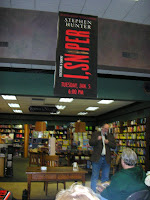 M. www.iloveamysterynewsletter.com. He answered a lot of questions during a 25 minute chat. I asked whether we could expect a Nick Memphis novel and he said no, that Nick is a great supporting character but he doesn't think he could carry an entire novel. Makes sense. He also said that the next book will feature a new, young sniper, sort of a protege for Bob Lee, who is getting a little long in the tooth. He signed books quickly and with dispatch and, all in all, it was quite the good time. The crowd was much larger than I had expected, maybe 50 people in all.
*** A week later Davis Kidd hosted the great grand-nephew of Bram Stoker, Dacre (pronounced Day-ker) Stoker, who along with Ian Holm used outtakes and unused plot bits, as well as the surviving notes from Bram, to produce a sequel to Dracula, namely Dracula-The Undead. I had expected an accent, maybe British, maybe Irish, but the one we heard was South Carolina. Go figure. Anyway, Stoker went into great detail about who Bram Stoker was, what might have influenced him to write Dracula, with Jack the Ripper being a surprise I had never considered, and where he and Holm found their research materials. He also laid out the family tree. The book has sold extremely well world-wide, yet Stoker remained approachable and quite humble. Nice guy. I wanted a photo with him but Davis Kidd doesn't have people to help with that sort of thing anymore, I guess, because nobody is ever around when I want one. So here's one I took after he signed my book and he was doing others.
Rumors of my demise are greatly exaggerated. As I've told you before, sometimes Life insists of intruding into my ventures in bookdom. So it has been. Did I tell you I'm back in school? Online courses are incredibly amazing. I submitted my first book report 10 days ago and have yet to get a grade. With my luck it'll probably be a C-.
*** Stephen Hunter was in at Davis Kidd Books in Memphis on January 5th, supporting his new book, I, Sniper. It's a Bob Lee Swagger book, maybe the best one to date. I have a full review currently up on ILA
 M. www.iloveamysterynewsletter.com. He answered a lot of questions during a 25 minute chat. I asked whether we could expect a Nick Memphis novel and he said no, that Nick is a great supporting character but he doesn't think he could carry an entire novel. Makes sense. He also said that the next book will feature a new, young sniper, sort of a protege for Bob Lee, who is getting a little long in the tooth. He signed books quickly and with dispatch and, all in all, it was quite the good time. The crowd was much larger than I had expected, maybe 50 people in all.
*** A week later Davis Kidd hosted the great grand-nephew of Bram Stoker, Dacre (pronounced Day-ker) Stoker, who along with Ian Holm used outtakes and unused plot bits, as well as the surviving notes from Bram, to produce a sequel to Dracula, namely Dracula-The Undead. I had expected an accent, maybe British, maybe Irish, but the one we heard was South Carolina. Go figure. Anyway, Stoker went into great detail about who Bram Stoker was, what might have influenced him to write Dracula, with Jack the Ripper being a surprise I had never considered, and where he and Holm found their research materials. He also laid out the family tree. The book has sold extremely well world-wide, yet Stoker remained approachable and quite humble. Nice guy. I wanted a photo with him but Davis Kidd
 doesn't have people to help with that sort of thing anymore, I guess, because nobody is ever around when I want one. So here's one I took after he signed my book and he was doing others.
Subscribe to:
Posts (Atom)

 Posts
Posts


